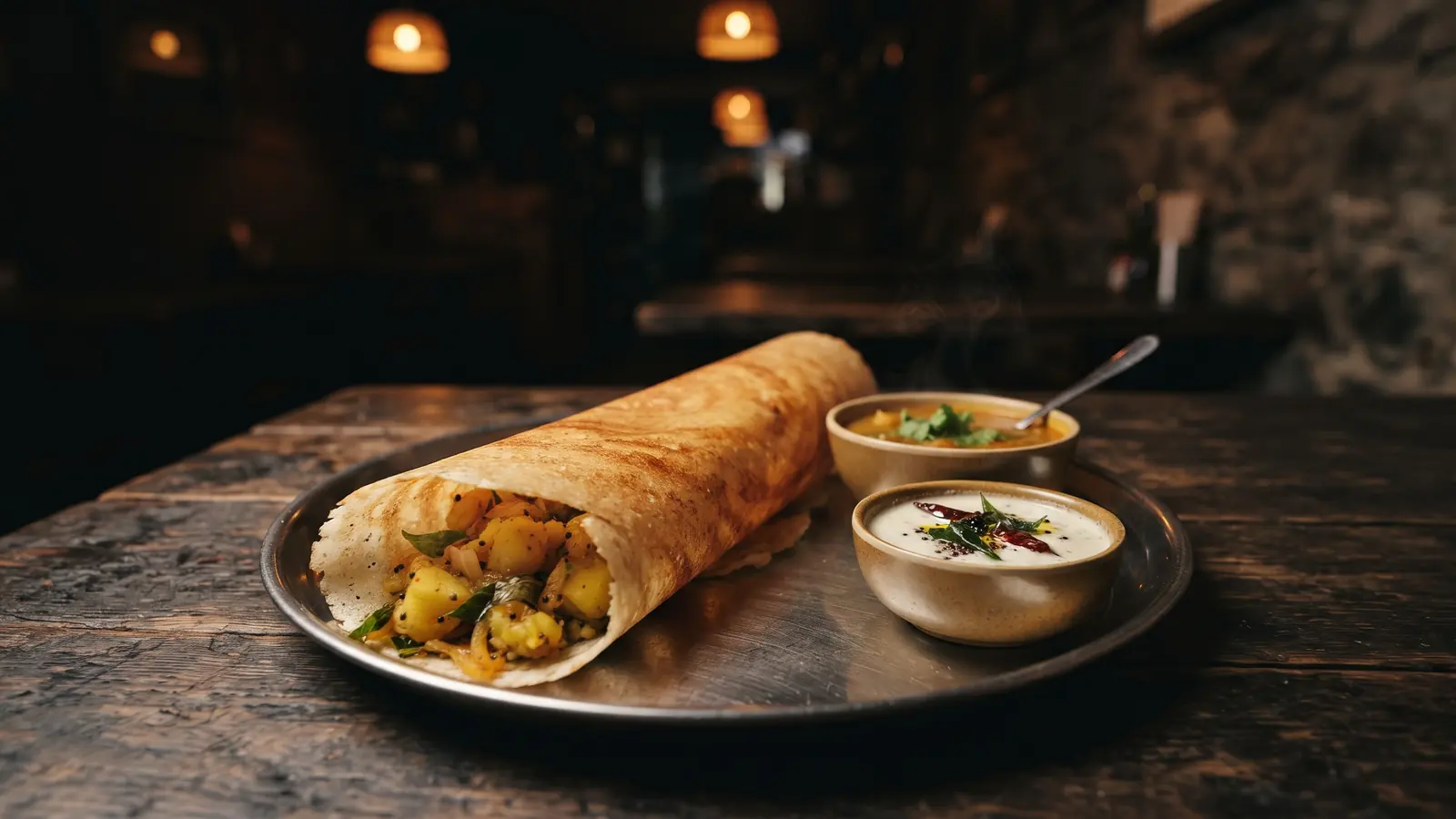
Short answer
Benne dosa is a soft, round dosa cooked with a generous amount of butter, which gives it a golden, rich surface. Benne means butter in Kannada, and the dish is most closely linked with Davanagere in central Karnataka.
Benne dosa is a soft, round, golden dosa cooked with plenty of butter, with benne meaning butter in Kannada. It is closely linked with Davanagere in central Karnataka. Unlike a thin, brittle masala dosa, a benne dosa is thicker and richer, and it is usually served with coconut chutney and a little extra butter.
What is benne dosa?
Benne dosa is a thick, tender dosa made from fermented rice and lentil batter and finished with a generous amount of white butter. The result is soft in the middle with a lightly crisp, golden surface.
The base batter is the same type used for other dosas: rice, split black lentils (urad dal) and fenugreek, fermented overnight. What makes a benne dosa distinct is thickness and butter. Some recipes add a little flattened rice (poha) or cooked rice to make the batter softer. The dosa is cooked on a hot flat griddle, usually on both sides, with butter spread on the surface.
Where does benne dosa come from?
Benne dosa is most often linked with Davanagere, a city in central Karnataka, India. Several local eateries there are known for serving it, and the dish is sometimes called Davanagere benne dosa.
The exact history is not clearly documented, and different eateries tell their own stories. It is safer to say that the dish is a regional Karnataka speciality, popular enough that Davanagere’s name travels with it. Karnataka is also the home of Mysore masala dosa and Udupi-style cooking, so the state has a wide range of dosas.
How is benne dosa different from masala dosa?
Benne dosa is soft, thick and butter-rich, while masala dosa is thin, crisp and filled with spiced potato. The two differ in thickness, richness and filling.
| Feature | Benne dosa | Masala dosa |
|---|---|---|
| Thickness | Thicker | Thin |
| Texture | Soft inside, lightly crisp outside | Very crisp |
| Fat | Plenty of fresh butter | Light oil or ghee |
| Filling | Usually none | Spiced potato |
| Typical sides | Chutney, extra butter, sometimes sambar | Coconut chutney and sambar |
A masala dosa is built to be a meal in a roll, while a benne dosa is a simpler, richer pancake that is eaten for its flavour and softness.
How is benne dosa made?
Benne dosa is made by pouring a thicker ladle of batter onto a hot griddle, spreading it into a small, thick round, adding butter around and on top and cooking until golden underneath. It is then often flipped briefly.
Here is a home method:
- Ferment a rice and urad dal batter overnight, and keep it a little thicker than for a thin dosa.
- Heat a tawa and grease it lightly.
- Pour a ladle of batter and spread it just a little, to a circle about the size of a side plate.
- Dot butter over the top and around the edge.
- Cook until the base turns golden, then flip for a moment if you like a crisper top.
- Serve hot with another small piece of butter on the dosa.
Because the dosa is thick, a medium heat works better than a very hot pan, which would brown the outside before the middle cooked.
What do you eat with benne dosa?
Benne dosa is served with coconut chutney and more butter, and often with sambar or a spiced potato curry. The chutney cuts the richness.
Typical accompaniments:
- White coconut chutney with green chilli
- A spoon of fresh white butter on top
- Sambar, for dipping
- A spicy red chutney or a dry lentil powder (podi)
- Potato palya, a dry spiced potato dish, in some places
Some eateries serve the dosa without sambar to keep the butter flavour in front.
Why does benne dosa stay soft?
Benne dosa stays soft because it is thick, cooked at a gentler heat and moistened with butter, which stops the surface from drying into a brittle shell. The fat coats the starch and keeps the crumb tender.
Three things help:
- A thicker batter spread only lightly, so the dosa keeps its depth.
- Medium heat, so the middle cooks through without scorching the base.
- Butter melted on the surface as it cooks, which seals in moisture.
Cooks who want a softer result sometimes ferment the batter a little longer or add a spoonful of cooked rice or flattened rice when grinding. The dosa is best eaten right away, since it firms up as it cools and the butter sets.
Which butter is used for benne dosa?
Benne dosa uses fresh white butter, the unsalted, homemade-style butter common in Karnataka households, rather than yellow cultured table butter. White butter, called benne or loni in different regions, has a mild, creamy taste.
At home, unsalted dairy butter is the easiest substitute. Salted butter works too, but reduce the salt in the batter slightly. Clarified butter (ghee) is a different product with a nuttier, more toasted flavour, so it changes the character of the dish even though it is a fine cooking fat for other dosas.
Benne dosa vs set dosa vs plain dosa: what is the difference?
Benne dosa is butter-rich and thick, set dosa is a stack of small, spongy dosas, and plain dosa is thin and crisp. All three share the same family of batter.
| Dosa | Size and thickness | Texture | Usual serving |
|---|---|---|---|
| Benne dosa | Medium round, thick | Soft with a golden surface | Chutney and butter |
| Set dosa | Small and thick, three or so in a stack | Spongy | Chutney and vegetable curry (saagu) |
| Plain dosa | Large and thin | Crisp | Chutney and sambar |
Is benne dosa on the Dosa Pointe menu?
No benne dosa is named in the public sources for Dosa Pointe. The restaurant is at 895 Rue Jean-Talon O in Montréal, and this guide is independent and does not take orders.
The recorded menu, checked in November 2026, names the Masala Dosa, Mysore Masala Dosa, Hara Bhara Dosa, Paneer Bhurji Dosa, Chicken Keema Dosa and Chettinad Lamb Keema Dosa. According to Tastet, close to 100 dishes are available, many of them dosa variations, so a plain list cannot show everything. If you want something soft and rich rather than crisp, the practical step is to phone and ask what the kitchen is making that day.
No prices were found in public sources, so none are given. The menu page lists the recorded dishes and the hours and location page shows the opening times found so far.
Common questions
What does benne mean?
Benne is the Kannada word for butter. A benne dosa is, quite literally, a butter dosa, named for the generous butter that is melted on and around it as it cooks.
Is benne dosa crisp or soft?
Benne dosa is usually thicker and softer than a paper-thin masala dosa, with a golden, lightly crisp surface and a tender middle. The exact texture varies from kitchen to kitchen.
Why is Davanagere famous for benne dosa?
Davanagere, a city in central Karnataka, is the place the dish is most often linked with, and several long-running local eateries are known for it. How the style began there is not clearly documented.
What do you eat with benne dosa?
Benne dosa is usually served with coconut chutney, a spoon of fresh white butter and sometimes sambar or a spicy potato curry. Many people also enjoy it with a plain red chutney.
Can you make benne dosa with ghee?
You can cook it in ghee, but it is not the same flavour. Benne dosa traditionally uses fresh white butter, and ghee gives a nuttier, more savoury result.
Looking for the basics? Dosa Pointe address and opening hours are on the home page.
This article is general information from an independent guide, not from Dosa Pointe itself. For the store’s current details see hours and location.