Short answer
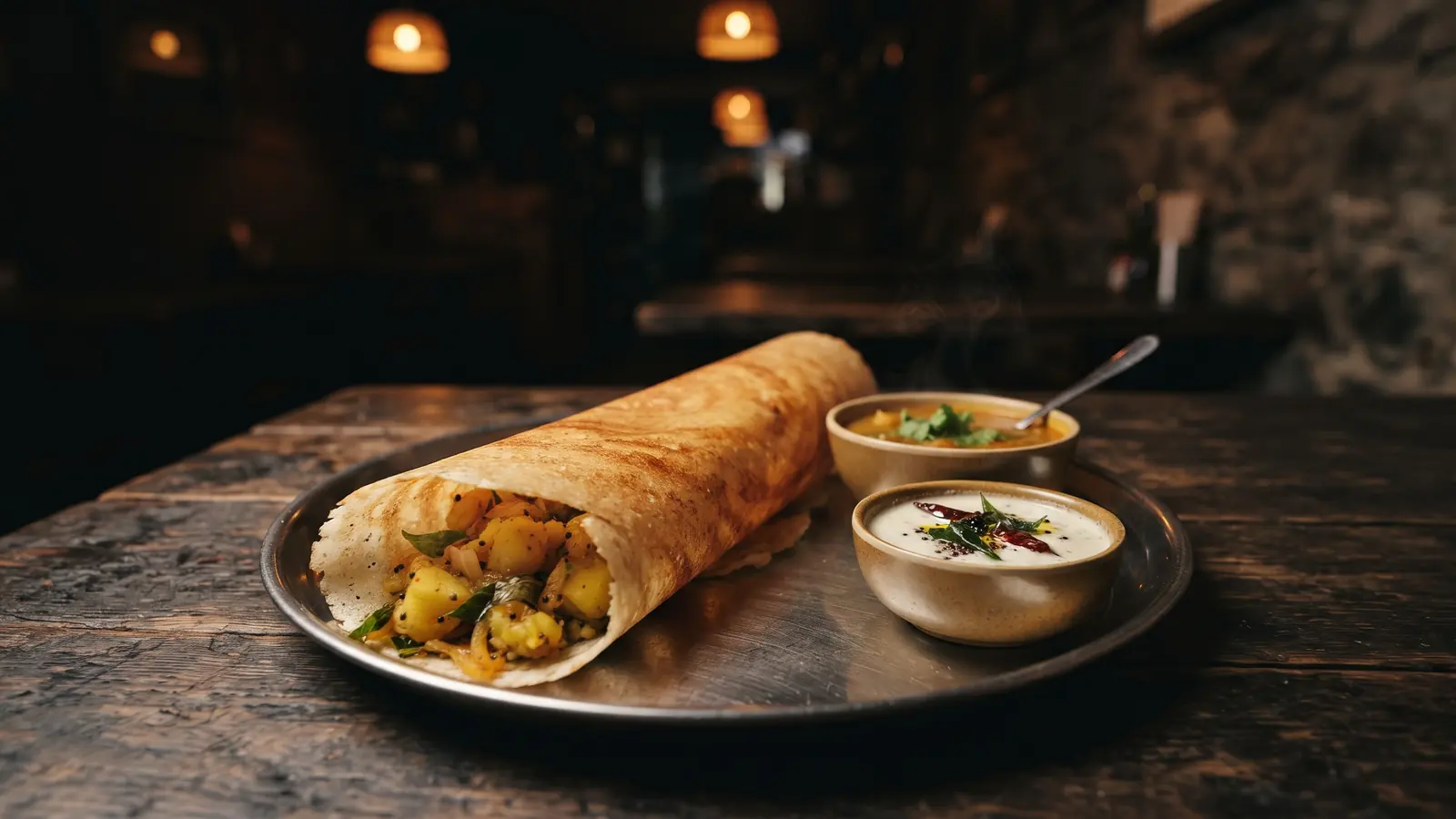
Dosa is a thin, crisp South Indian pancake made from a fermented batter of rice and black lentils (urad dal), cooked on a hot griddle. It is served with chutneys and sambar, and is often filled with spiced potato or other fillings.
Dosa is a thin, crisp pancake from South India, made from a fermented batter of rice and black lentils and cooked on a hot flat griddle. If you are asking what is dosa food, the short version is this: a golden, lightly sour crepe-like pancake, often rolled around spiced potato and served with chutneys and sambar.
What is dosa made of?
Dosa is made from just a few ingredients: rice, split black lentils (urad dal), a pinch of fenugreek seeds, water and salt. The rice and lentils are soaked, ground into a smooth batter and left to ferment.
The lentils give the batter body and help it ferment, while the rice gives the crisp texture. A common starting ratio is about three or four parts rice to one part urad dal by volume, though cooks vary it. Some kitchens add a little cooked rice or flattened rice (poha) for softness.
How is dosa batter fermented?
Dosa batter ferments when natural yeasts and bacteria in the soaked, ground rice and lentils feed on the starch and produce gas. The batter is left covered in a warm place, typically overnight or for eight to twelve hours.
You can tell it is ready when the batter has risen, looks bubbly and smells pleasantly tangy. In a cold kitchen, fermentation takes longer, which is why many home cooks in cooler places leave the batter near a warm appliance or in an oven with only the light on.
Fermentation does three things for dosa:
- It makes the batter light and airy so it spreads thin.
- It builds a mild sour flavour.
- It helps the dosa brown evenly and turn crisp at the edges.
What does dosa taste like?
Dosa tastes mildly sour, slightly nutty and savoury, with a crisp, brittle outside and a softer, chewy centre. On its own the dosa is gentle in flavour, which is why chutneys and sambar are served with it.
The tang comes from fermentation, not from added acid. A thin, well-browned dosa has a toasty, lacy crunch, while a thicker one is softer and more bread-like. The filling or the chutney then supplies the spice, heat and freshness.
How is a dosa cooked?
A dosa is cooked by pouring a ladle of batter onto a hot, lightly oiled griddle (tawa) and spreading it in a circle with the back of the ladle. The dosa cooks in a couple of minutes without needing to be flipped.
Here is the usual method:
- Heat a flat griddle until a drop of water sizzles and disappears.
- Wipe it with a little oil.
- Pour a ladle of batter in the centre.
- Spread it outward in a spiral with the bottom of the ladle, making a thin round.
- Drizzle a little oil or ghee around the edges.
- Cook until the underside is deep golden and the top looks dry.
- Add a filling if using, then fold or roll and serve at once.
The pan matters. A well-seasoned cast iron or carbon steel tawa gives the best browning, and a griddle that is too cold makes the batter stick and tear.
What are the main types of dosa?
The main types of dosa differ by thickness, batter, filling and region. Plain dosa and masala dosa are the best known, but there are dozens of variations across South India.
| Type | What defines it | Texture |
|---|---|---|
| Plain dosa | Just the pancake, no filling | Thin and crisp |
| Masala dosa | Filled with spiced potato | Crisp outside, soft filling |
| Mysore masala dosa | Spread inside with a red chutney, then filled | Crisp with a spicy layer |
| Set dosa | Small, thick, soft pancakes served in a stack | Spongy |
| Rava dosa | Made with semolina, poured as a lacy pattern | Very crisp and netted |
| Paper dosa | Very large, very thin | Brittle and long |
| Keema dosa | Filled with spiced minced meat | Crisp with a meaty filling |
Names and recipes vary between regions and restaurants, so the same name can mean slightly different dishes in different kitchens.
What do you eat with dosa?
Dosa is traditionally eaten with sambar, a lentil and vegetable stew, and with coconut chutney, and often a red or tomato chutney too. These sides are for dipping and scooping, not for pouring over.
Common accompaniments include:
- Sambar, a tamarind-tinged lentil and vegetable stew
- White coconut chutney, made with grated coconut, green chilli and roasted chana dal
- Red chutney, made with chillies and often tomato or onion
- Podi, a dry spice and lentil powder mixed with oil or ghee
- Spiced potato filling, sometimes served on the side
How do you eat a dosa?
You eat a dosa by tearing off a piece with your fingers, using it to scoop sambar, chutney or filling, and putting it in your mouth. Using the right hand is traditional, though cutlery is always fine.
If the dosa is rolled or folded, break the crisp end first and work inward. A filled dosa such as masala dosa is easy to eat as you go: tear a strip of the crisp shell, then take a little of the potato with it. Dip each piece rather than drowning the dosa, so the crisp parts stay crisp.
Dosa vs crepe vs uttapam: what is the difference?
Dosa is a thin fermented pancake, a crepe is a thin unfermented wheat pancake, and uttapam is a thick fermented one. All three are flat, but they differ in batter and thickness.
| Dish | Batter | Thickness | Typical result |
|---|---|---|---|
| Dosa | Fermented rice and urad dal | Thin | Crisp, slightly sour |
| French crepe | Wheat flour, egg and milk | Thin | Soft, tender, not sour |
| Uttapam | Fermented rice and urad dal | Thick | Soft with toppings cooked in |
Dosa is also related to idli, which uses the same fermented batter but is steamed in moulds instead of cooked on a griddle.
What dosas are named in public sources for Dosa Pointe?
Dosa Pointe is a South Indian restaurant at 895 Rue Jean-Talon O in Montréal, and public sources name several dosas on its menu. This guide is independent and does not take orders.
The restaurant’s recorded menu, drawn from a Tastet review, The Main and Google Maps reviews and checked in November 2026, names these dosas:
- Masala Dosa, the classic with spiced potato
- Mysore Masala Dosa
- Hara Bhara Dosa, a vegetarian dosa
- Paneer Bhurji Dosa, filled with scrambled paneer
- Chicken Keema Dosa, filled with spiced minced chicken
- Chettinad Lamb Keema Dosa, named in one listing
Tastet says the restaurant has many dosa variations. No prices were found, so none are given here. See the menu page for the full recorded list and the hours and location page before you go, and call the restaurant to confirm what is available.
Common questions
Is dosa the same as a crepe?
They look alike, but a dosa uses fermented rice and lentil batter with no egg, milk or wheat flour. That fermentation gives dosa its mild sour taste and crisp, lacy texture, which a French crepe does not have.
Is dosa gluten-free?
A traditional dosa batter contains only rice, lentils, fenugreek and salt, so it contains no wheat. Some restaurants add semolina or flour to certain dosas, so anyone avoiding gluten should ask the kitchen about each dish.
How many dosas make a meal?
A large restaurant dosa, especially a filled one such as masala dosa, is often a full meal on its own. Smaller plain dosas are usually eaten two or three at a time, with chutneys and sambar.
What is the difference between dosa and uttapam?
Dosa is spread thin and cooked crisp, while uttapam uses the same kind of batter but is poured thick and cooked soft, with toppings such as onion and tomato cooked into the top.
Can you eat dosa with your hands?
Yes. Dosa is traditionally eaten by hand: tear off a piece, scoop up filling, chutney or sambar and eat it. Many restaurants also give cutlery if you prefer it.
This page is part of the independent guide to Dosa Pointe, which has the address, hours and menu.
This article is general information from an independent guide, not from Dosa Pointe itself. For the store’s current details see hours and location.